
How to Choose the Right FTTH Drop Cable?
Choosing the right FTTH drop cable is essential for building a reliable last-mile fiber connection.
The cable structure should match the actual installation route. A cable used inside a building has different requirements from one installed in an underground duct, suspended between poles, or routed continuously from outdoors to an indoor termination point.
This guide introduces four common FTTH drop cable types and explains how to select a suitable option based on the installation environment, fiber type, strength member, and jacket material.
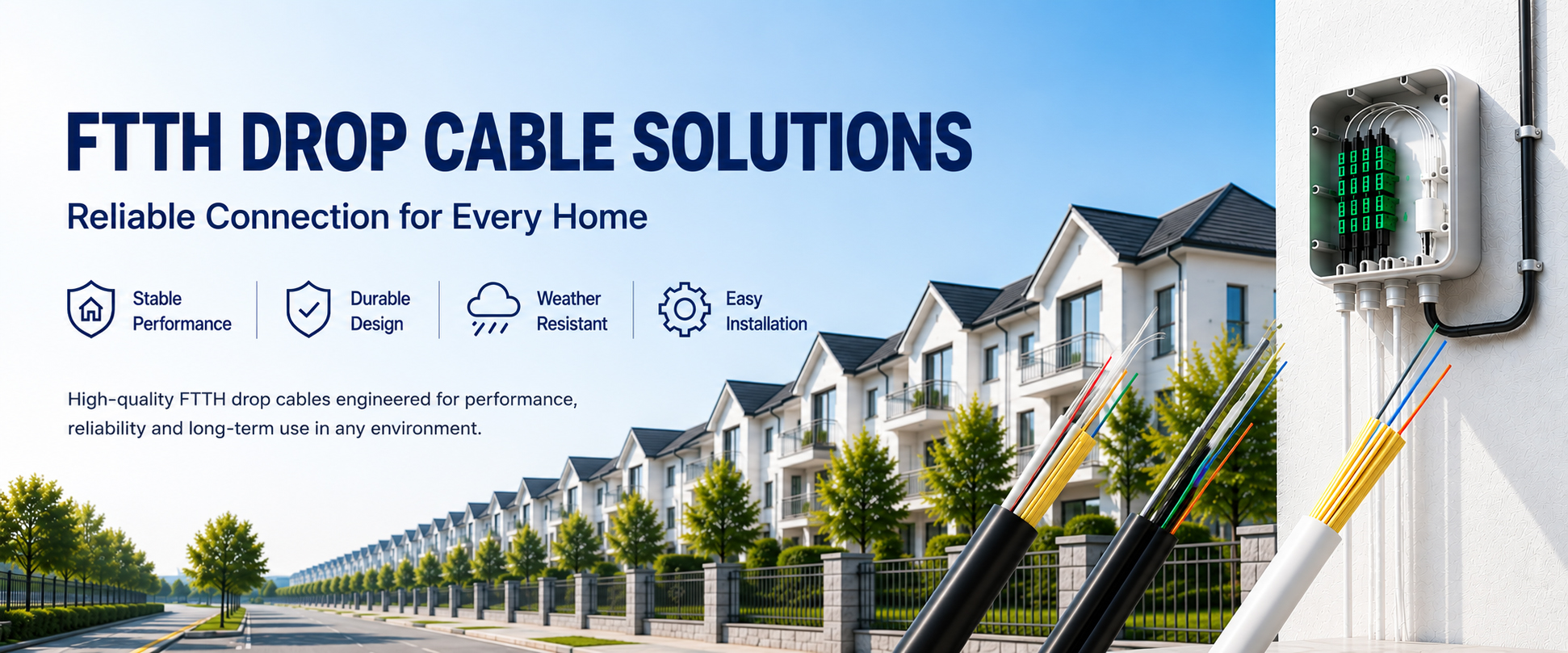
What is an FTTH Drop Cable?
An FTTH drop cable is the final section of fiber optic cable connecting a network distribution point to a subscriber’s home, apartment, office, or commercial building.
Compared with feeder and distribution cables, drop cables are generally smaller, lighter, and easier to install in limited spaces. Depending on the network design, they may be installed indoors, inside underground ducts, on aerial routes, or across both indoor and outdoor environments.
Most FTTH drop cables use bend-insensitive single-mode fiber, such as G.657.A1 or G.657.A2. These fibers are suitable for wall corners, narrow conduits, compact termination boxes, and other routes where bending may occur during installation.
The cable structure, strength member, and jacket material should always be selected according to the installation method.
FTTH drop cables are designed for different installation environments. The following are the four most common types used in modern fiber optic access networks.
Common Types of FTTH Drop Cables
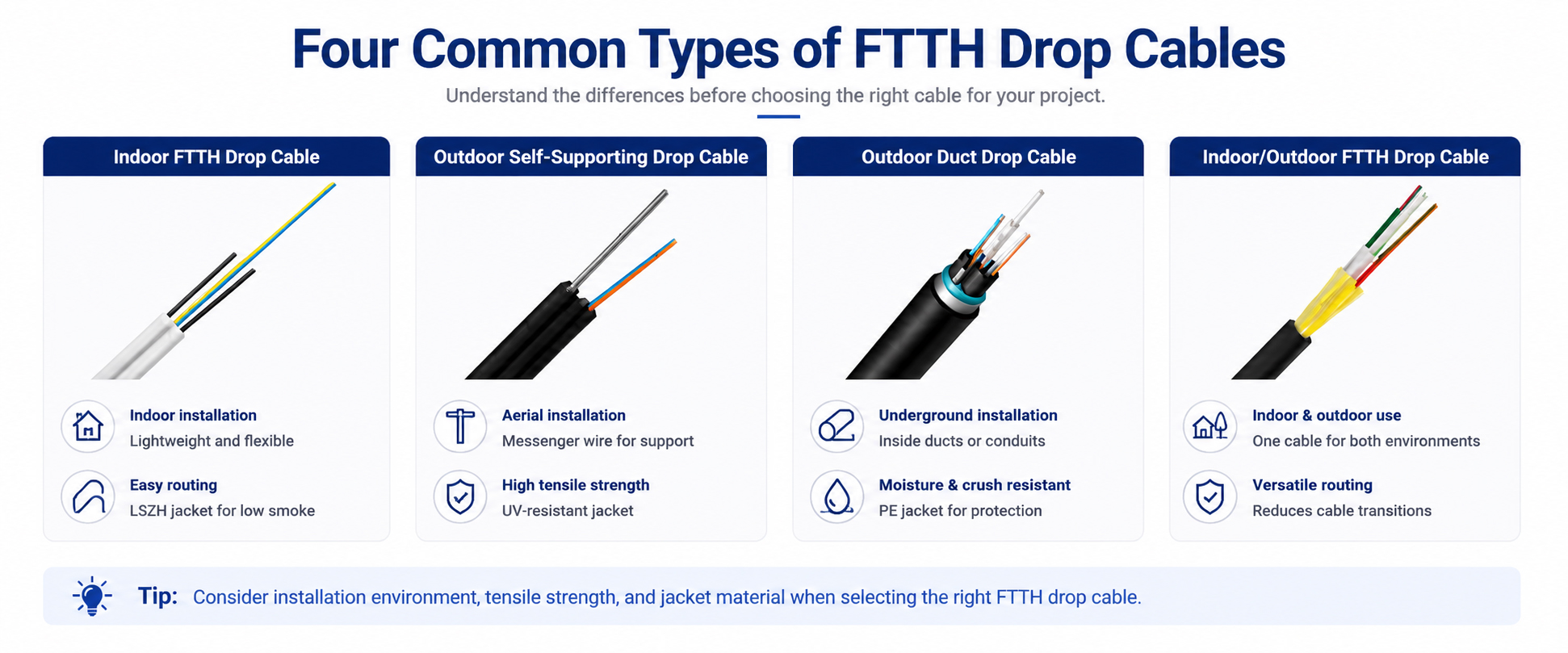
1. Indoor FTTH Drop Cable
Indoor FTTH drop cables are designed for routing inside apartments, offices, residential buildings, and other indoor environments.
They are normally lightweight and flexible, making them easy to install along walls, through conduits, and inside cable trays. LSZH jackets are commonly used where low-smoke and halogen-free performance is required.
Typical applications
- Apartments and residential buildings
- Offices and commercial premises
- Indoor optical outlets
- Connections from building entry boxes to user terminals
2. Outdoor Duct Drop Cable
Outdoor duct drop cables are designed for installation inside underground ducts, conduits, or other protected outdoor pathways.
Compared with standard indoor cables, they generally provide better resistance to moisture, external pressure, and changing outdoor temperatures.
Typical applications
- Underground access networks
- Residential communities
- Campus networks
- Municipal broadband projects
3. Outdoor Self-Supporting Drop Cable
Outdoor self-supporting drop cables are mainly used for aerial connections between utility poles and subscriber buildings.
They normally include an integrated messenger wire that supports the cable during suspended installation and provides the tensile strength required for pole-to-house routing.
Typical applications
- Pole-to-house connections
- Rural broadband networks
- Residential aerial FTTH
- Low-rise building access
4. Indoor/Outdoor FTTH Drop Cable
Indoor/outdoor FTTH drop cables are designed for routes that begin outside a building and continue directly to an indoor termination point.
Using one cable across both environments can reduce cable transitions, simplify installation, and reduce the number of accessories required at the building entrance.
Typical applications
- Residential FTTH projects
- Apartment buildings
- Commercial buildings
- Outdoor entry points connected directly to indoor terminals
- European broadband deployments
FTTH Drop Cable Comparison Table
|
Cable Type |
Installation Environment |
Main Advantage |
Typical Application |
|---|---|---|---|
|
Indoor FTTH Drop Cable |
Indoor |
Flexible and easy to route |
Apartments, offices and indoor access |
|
Outdoor Duct Drop Cable |
Underground duct or conduit |
Better moisture and crush resistance |
Duct networks and underground access |
|
Outdoor Self-Supporting Drop Cable |
Aerial |
Messenger wire supports suspended installation |
Pole-to-house and rural FTTH |
|
Indoor/Outdoor Drop Cable |
Mixed indoor and outdoor route |
Reduces cable transitions |
Residential and commercial building access |
How to Choose the Right FTTH Drop Cable
A practical selection process should begin with the actual installation route rather than cable appearance or price.
Selecting the appropriate FTTH drop cable depends on installation conditions, environmental requirements and project specifications. The following factors should be considered before making a decision.
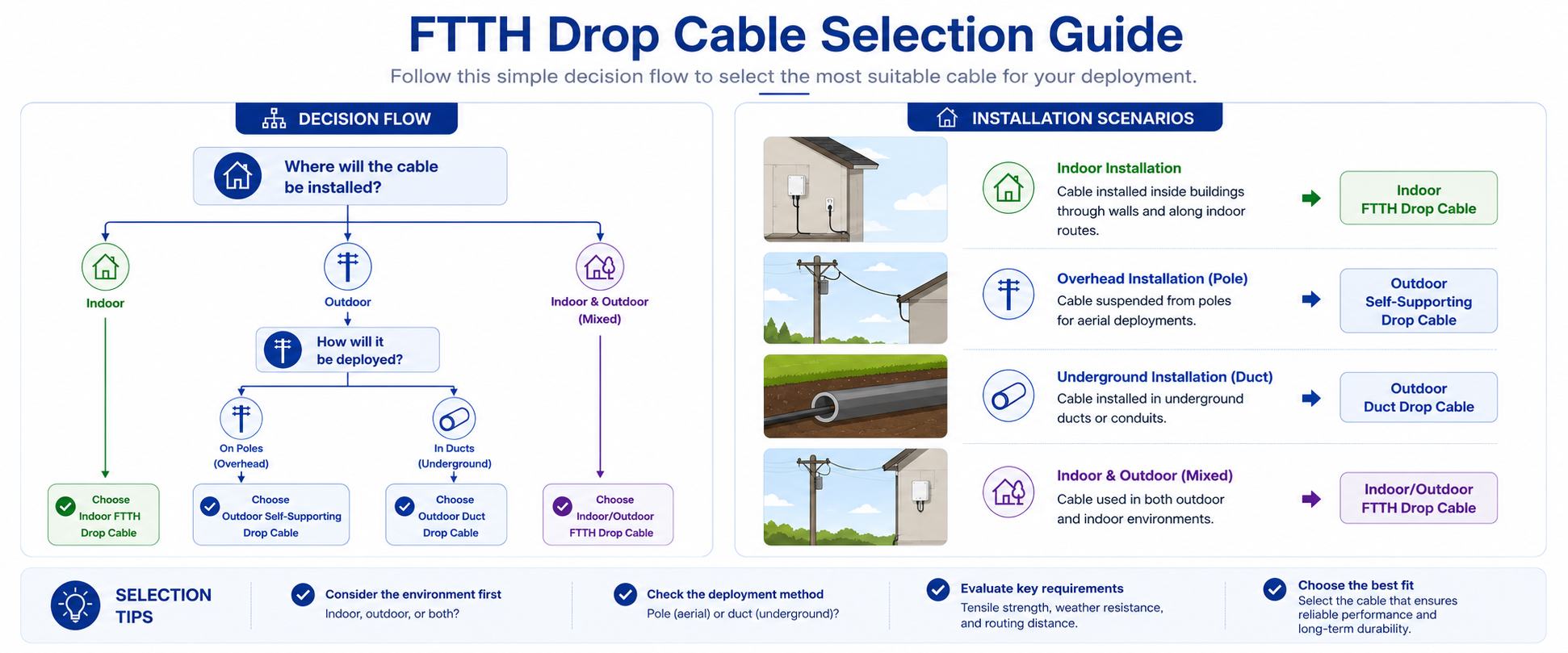
Step 1: Confirm the Installation Environment
The installation route determines the basic cable type.
- Choose an indoor drop cable for wall, conduit, or cable-tray routing inside buildings.
- Choose an outdoor duct cable for underground ducts and conduits.
- Choose a self-supporting cable for aerial pole-to-house connections.
- Choose an indoor/outdoor cable when one cable must run continuously from outside the building to an indoor termination point.
Selecting the correct structure at this stage helps avoid installation and performance problems later.
Step 2: Select the Fiber Type
G.657.A1 and G.657.A2 are commonly used in FTTH networks because they offer better bending performance than conventional single-mode fiber.
G.657.A2 is often preferred for narrow conduits, compact boxes, wall corners, and routes with tighter bends.
The final fiber specification should follow the network design, operator requirements, and applicable project standards.
Step 3: Choose the Strength Member
The strength member protects the fiber from tensile and mechanical stress.
Common options include:
- Steel wire: Provides good tensile and crush resistance
- FRP: Lightweight, non-metallic, and electrically insulating
- Aramid yarn: Adds tensile strength while maintaining flexibility
- Messenger wire: Supports aerial cable installation
The correct choice depends on the installation method, required tensile load, and electrical environment.
Step 4: Confirm the Jacket Material
The jacket material should match the operating environment.
- LSZH is commonly used for indoor applications.
- PE is commonly used for outdoor applications.
- UV-resistant LSZH may be suitable for certain indoor/outdoor routes.
Buyers should also confirm fire-performance requirements, UV resistance, operating temperature, and local regulations before placing an order.
Quick Selection Guide
|
Project Requirement |
Recommended Cable Type |
Main Reason |
|---|---|---|
|
Indoor apartment or office routing |
Indoor FTTH Drop Cable |
Flexible and suitable for indoor installation |
|
Underground duct connection |
Outdoor Duct Drop Cable |
Better moisture and crush resistance |
|
Pole-to-house aerial route |
Outdoor Self-Supporting Drop Cable |
Messenger wire supports suspended installation |
|
Outdoor entry directly into a building |
Indoor/Outdoor Drop Cable |
One cable can cover both environments |
Why Indoor/Outdoor Drop Cable Is Popular in European FTTH Projects
A conventional installation may use one outdoor cable and one indoor cable connected at the building entrance. This creates an additional transition point and may require more accessories and installation work.
Where project standards permit, an indoor/outdoor drop cable allows one cable to cover both sections of the route.
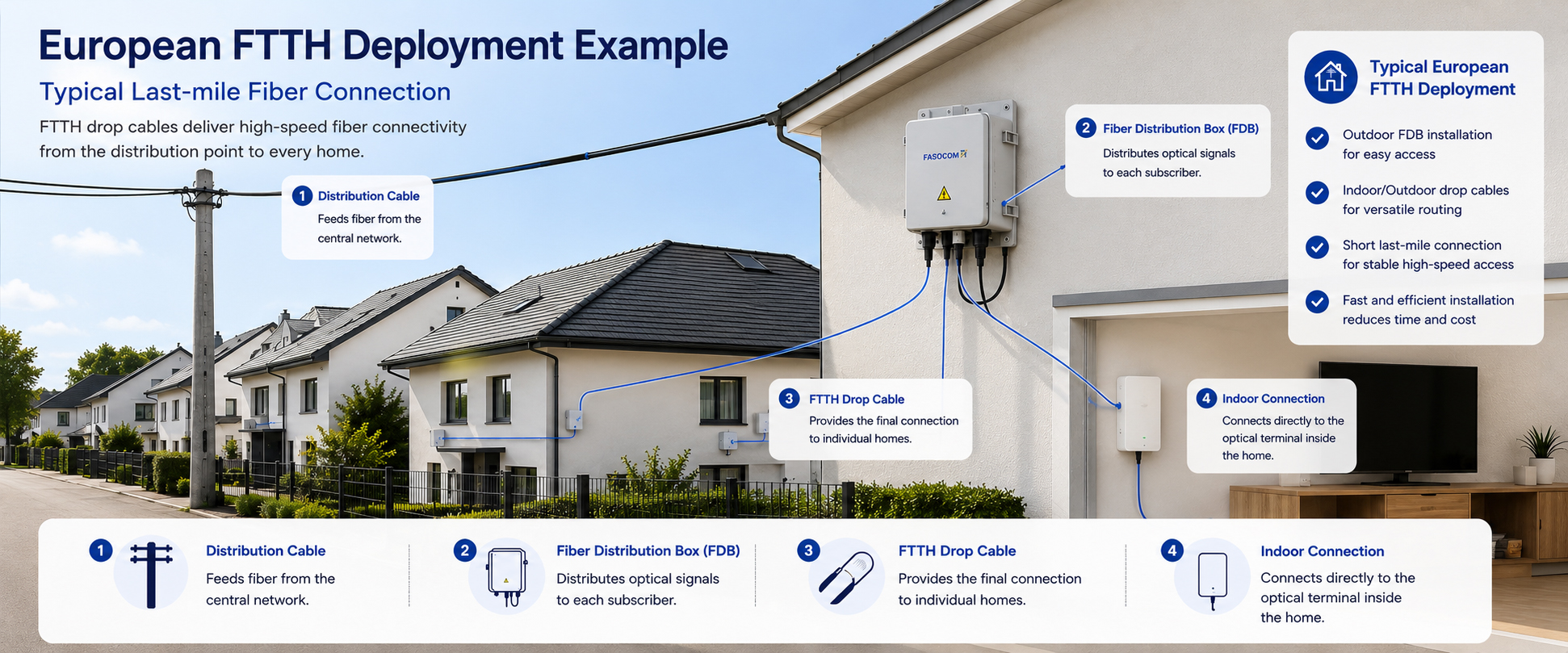
This can provide several practical benefits:
- Fewer cable transitions
- Faster installation
- Fewer accessories
- Simpler inventory management
- Easier routing in compact residential buildings
However, the selected cable must still meet the required outdoor durability and indoor fire-safety standards. Local regulations, operator specifications, and project requirements should always be confirmed before selection.
Conclusion
There is no single FTTH drop cable suitable for every installation.
Indoor cables are designed for flexible routing inside buildings. Outdoor duct cables provide stronger environmental protection. Self-supporting cables are used for aerial connections, while indoor/outdoor cables can simplify continuous routing from an outdoor access point into a building.
The most reliable selection method is to begin with the installation route and then confirm the fiber type, strength member, jacket material, and applicable project standards.
Selecting the right FTTH drop cable is more than choosing a product—it is about ensuring reliable network performance throughout the entire lifecycle of the fiber infrastructure.
By understanding different cable structures and installation environments, network builders can reduce deployment costs, improve installation efficiency and build more reliable FTTH networks.
Need Help Choosing the Right FTTH Drop Cable?
FASOCOM provides indoor, outdoor duct, self-supporting, and indoor/outdoor FTTH drop cable solutions for different access-network applications.
Send us your installation environment, required cable structure, fiber type, cable length, and project standards. Our team will help review the specification and recommend a suitable solution.
