MPO vs. LC: Which Connector Fits Your Data Center?
As data centers continue to support higher bandwidth and greater network density, choosing the right fiber optic connector is essential for building reliable and scalable cabling systems. Among the most common options, MPO and LC connectors are designed for different network requirements and applications.
MPO connectors are typically used for high-density backbone cabling and parallel optical transmission, while LC connectors are widely deployed for duplex connections between switches, servers, transceivers, and patch panels. Although both are essential in modern data centers, they are designed for different purposes and cannot simply replace one another.
This guide compares MPO and LC connectors, explains their key differences, and helps you choose the right solution based on your network architecture, transmission requirements, and future expansion plans.
Understanding MPO and LC Connectors
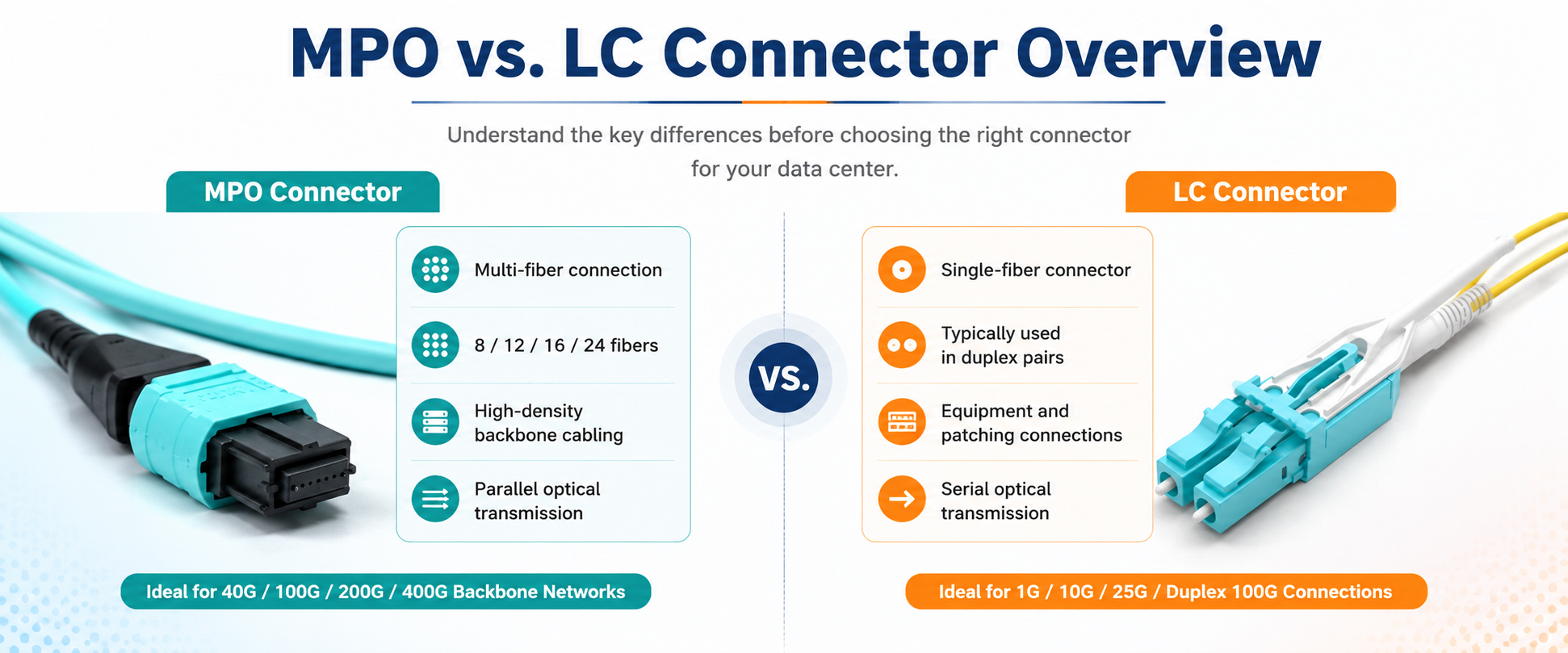
Both MPO and LC connectors are widely used in modern fiber optic networks, but they are designed for different transmission methods and deployment scenarios. Understanding their characteristics is the first step in selecting the right connector for your data center.
What Is an MPO Connector?
An MPO (Multi-fiber Push-On) connector is a high-density fiber optic connector that integrates multiple fibers into a single interface. Available in configurations such as 8, 12, 16, and 24 fibers, MPO connectors are commonly used for high-speed backbone cabling and parallel optical transmission in modern data centers.
What Is an LC Connector?
An LC (Lucent Connector) is a compact duplex fiber optic connector designed for point-to-point fiber links. Its small form factor and broad compatibility make it one of the most widely used connectors for switches, servers, transceivers, storage systems, and patch panels.

MPO vs. LC Comparison Table
| Feature | MPO Connector | LC Connector |
|---|---|---|
| Fiber Count | 8, 12, 16, or 24 fibers | Single fiber (typically used in duplex pairs) |
| Transmission Method | Parallel optical transmission | Serial optical transmission |
| Typical Applications | Backbone cabling, trunk links, high-density data centers | Equipment connections, patch panels, enterprise networks |
| Supported Speeds | 40G / 100G / 200G / 400G | 1G / 10G / 25G / Duplex 100G |
| Port Density | Very High | Standard |
| Cable Management | Reduces cable congestion | Easy to install and maintain |
| Future Scalability | Excellent for network expansion | Suitable for stable network deployments |
When to Choose MPO?
MPO connectors are the preferred choice for high-density backbone cabling in modern data centers. By integrating multiple fibers into a single connector, they simplify cable management, reduce installation time, and maximize rack space utilization.
MPO is particularly suitable for 40G, 100G, 200G, and 400G Ethernet networks, where parallel optical transmission is required. It is also widely used in spine-leaf architectures, inter-rack connections, and large-scale cloud or AI data centers that demand high bandwidth and future scalability.
If your project requires rapid deployment, easier upgrades, and support for increasing network capacity, MPO is typically the better long-term solution.
When to Choose LC?
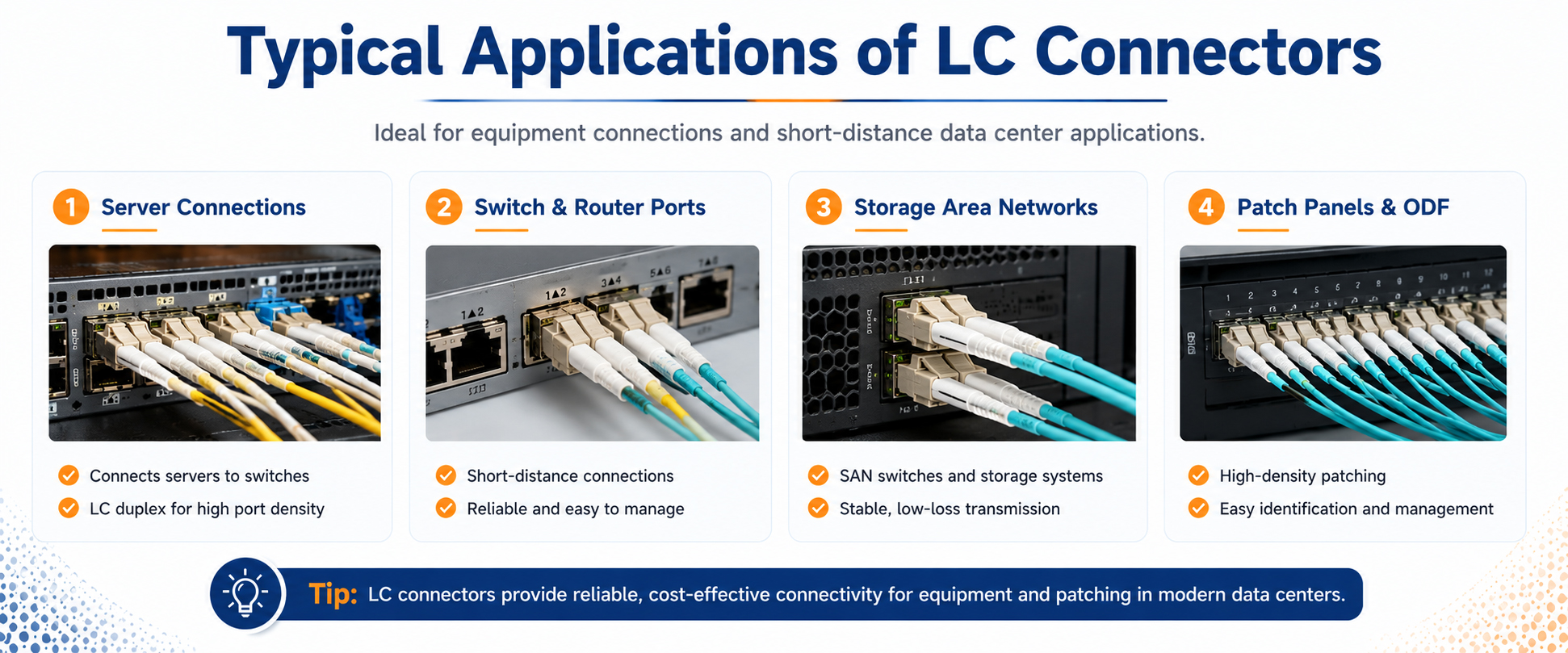
LC connectors remain the standard solution for point-to-point equipment connections in enterprise and data center networks. Their compact size, reliable performance, and broad compatibility make them ideal for connecting switches, servers, transceivers, storage devices, and patch panels.
LC connectors are commonly used in 1G, 10G, 25G, and duplex 100G applications, where flexibility, simple maintenance, and cost-effective deployment are priorities. They are also well suited to existing network infrastructures that do not require high-density parallel optical transmission.
For equipment-level connectivity and conventional duplex fiber links, LC continues to be the most practical and widely adopted connector.
Conclusion
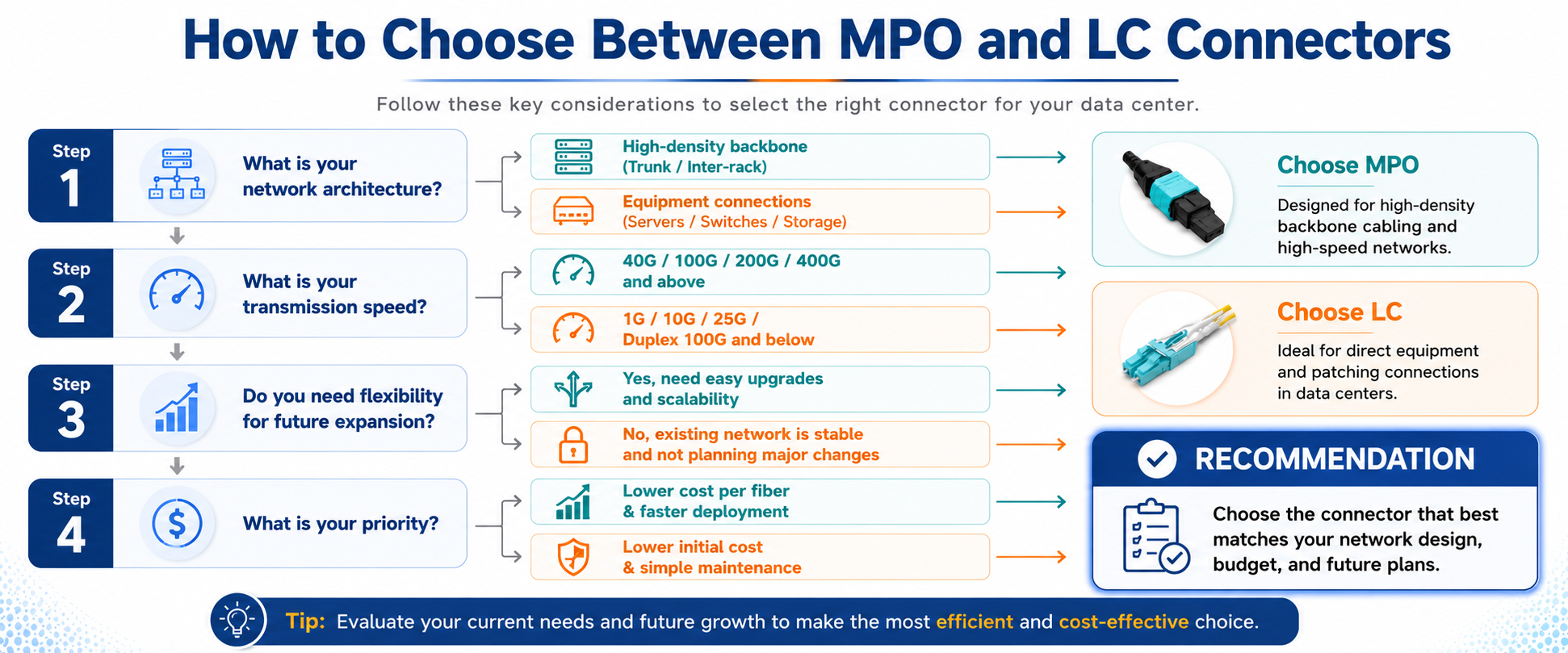
Choosing between MPO and LC connectors is not about determining which one is better—it is about selecting the right solution for your specific network architecture and application.
MPO connectors provide high-density, high-speed connectivity for backbone cabling and future network expansion, while LC connectors remain the preferred choice for equipment connections and conventional duplex fiber links. In many modern data centers, both connector types work together to create an efficient, scalable, and reliable cabling infrastructure.
By understanding their differences and deployment scenarios, you can make informed decisions that improve network performance while supporting future growth.
Need Help Choosing the Right Fiber Optic Connector?
Whether you’re building a new data center, upgrading an existing network, or looking for reliable fiber optic connectivity, selecting the right connector is essential for long-term performance.
FASOCOM provides a comprehensive range of MPO/MTP solutions, LC fiber patch cords, high-density cabling systems, and customized fiber optic products to meet the requirements of enterprise, cloud, and hyperscale data centers.
Contact our team today to discuss your project and find the right fiber optic solution for your network.
