How to Choose the Right Fiber Optic Splice Closure?
A fiber optic splice closure protects fiber splicing points from water, dust, mechanical stress, UV exposure, and other environmental risks. It also organizes splice trays, cable entries, and fiber routing so technicians can install, inspect, and maintain the network safely.
However, splice closures differ significantly in housing structure, sealing method, splice capacity, cable entry design, and installation requirements. A closure that works well for an aerial FTTH network may not be suitable for underground ducts, direct burial, or high-capacity backbone applications.
This guide explains how fiber optic splice closures are classified, compares dome and horizontal structures, introduces heat-shrink and mechanical sealing systems, and outlines the key factors to consider before selecting a closure for your project.
What Is a Fiber Optic Splice Closure??
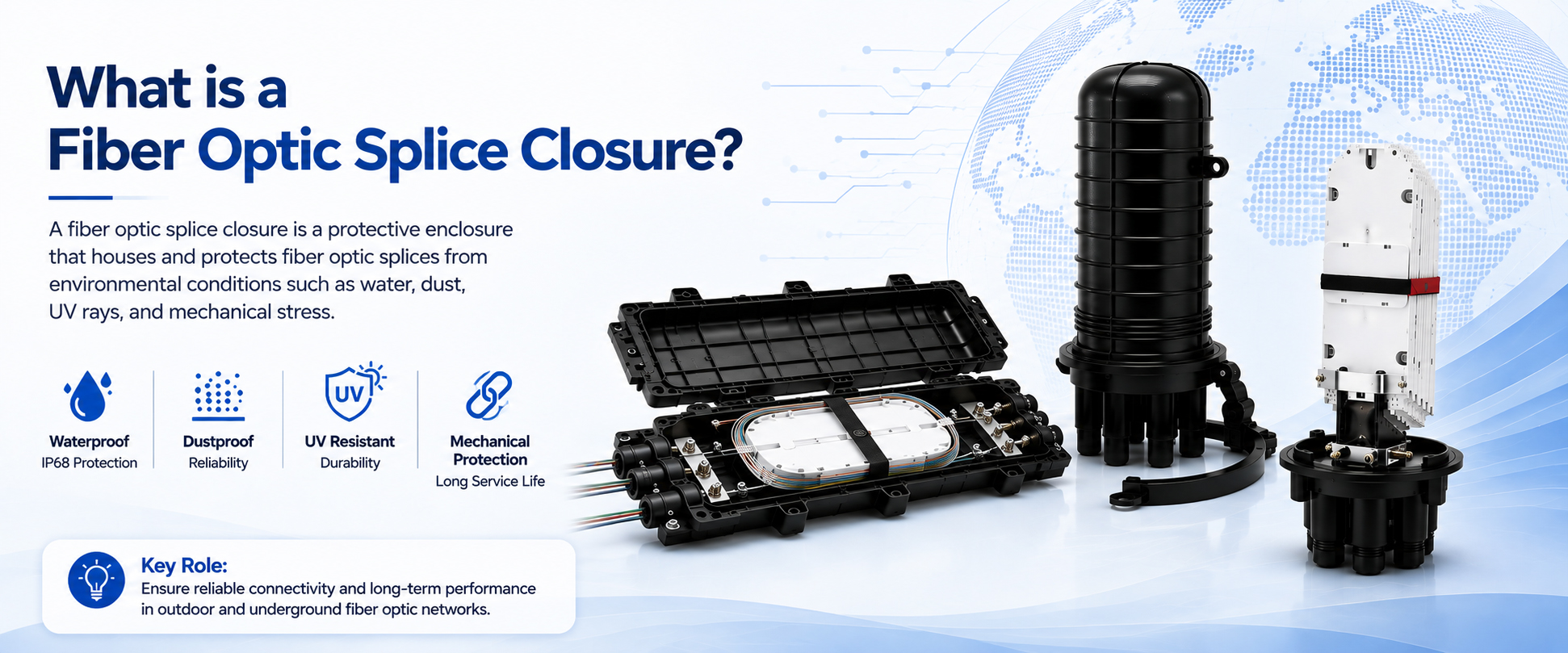
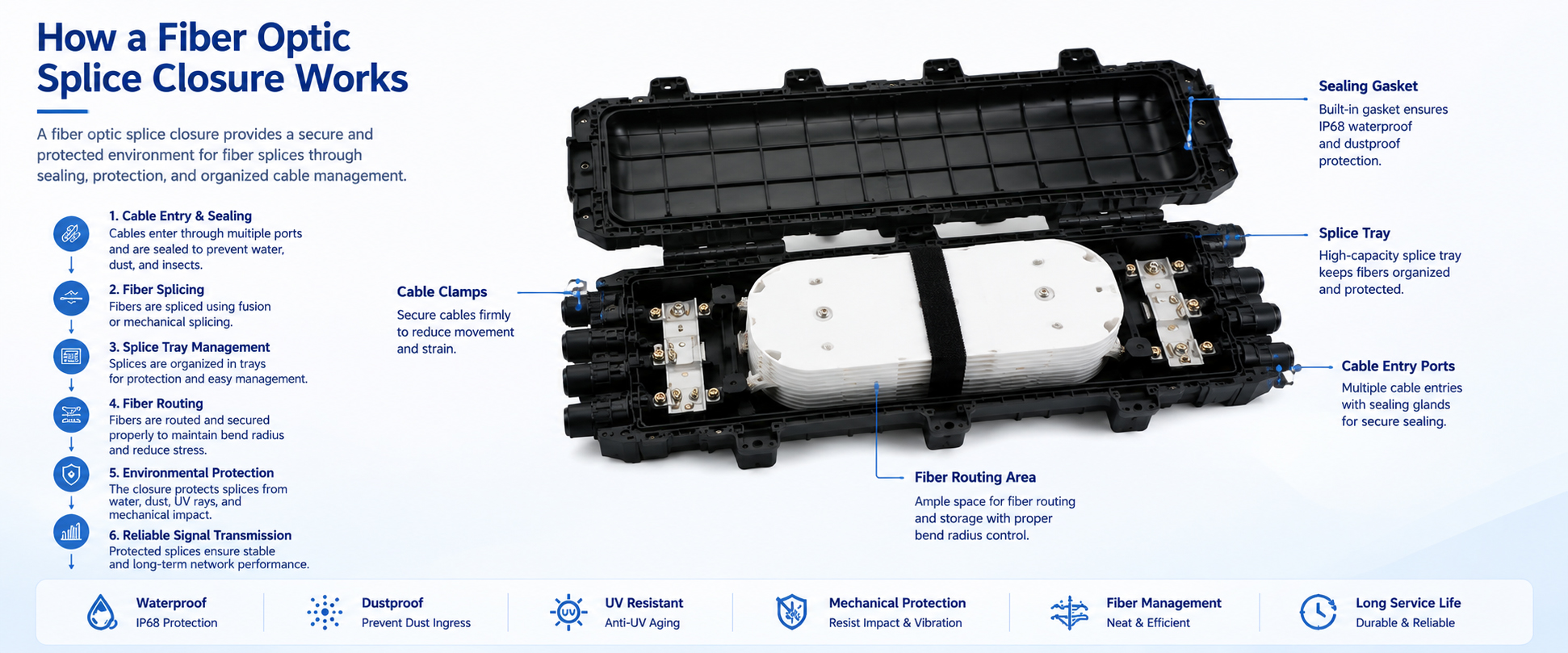
A fiber optic splice closure is a protective enclosure designed to safeguard fiber optic splices from environmental factors such as moisture, dust, UV exposure, and mechanical impact. It provides a secure space for organizing splice trays, managing fiber routing, and ensuring long-term network reliability in both indoor and outdoor installations.
Fiber optic splice closures are widely used in FTTH access networks, telecommunications infrastructure, data transmission systems, and outdoor backbone networks. Depending on the installation environment and application requirements, different closure designs offer varying capacities, sealing methods, and cable entry configurations.
Choosing the right splice closure not only protects the fiber connections but also simplifies installation, future maintenance, and network expansion.
Three Main Types of Fiber Optic Splice Closures
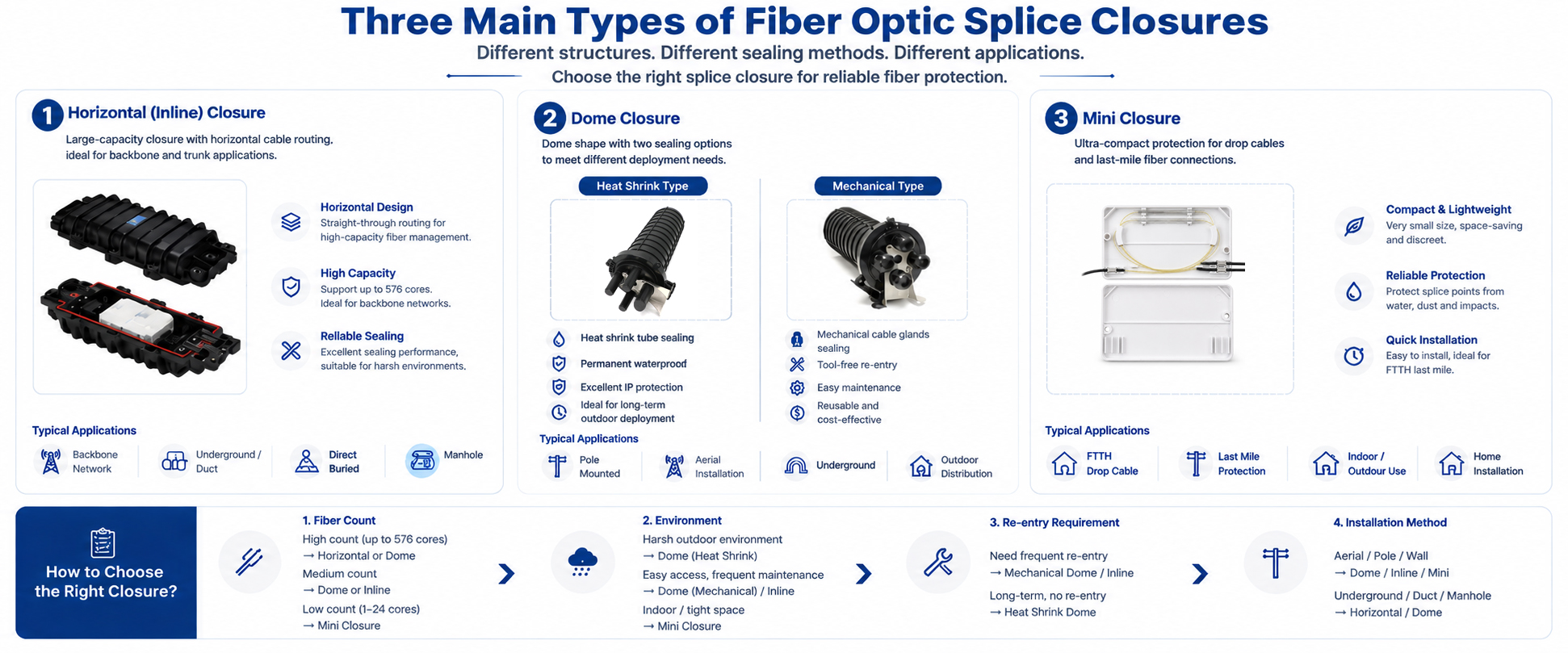
Fiber optic splice closures are available in different designs to accommodate various installation environments, cable configurations, and maintenance requirements. Selecting the appropriate closure type helps improve installation efficiency, network reliability, and long-term protection.
1. Horizontal (Inline) Closure
Horizontal splice closures, also known as inline closures, are designed for straight-through cable routing. They are commonly used in underground ducts, direct-buried installations, aerial networks, and backbone fiber systems. Their robust housing and flexible cable entry design make them suitable for medium- to high-capacity fiber networks.
2. Dome Closure
Dome closures feature a vertical enclosure that provides excellent sealing performance and efficient fiber management. Depending on the cable sealing system, dome closures are generally available in two configurations:
- Heat Shrink Type – Uses heat-shrink tubes to create a permanent seal with outstanding waterproof performance, making it ideal for harsh outdoor environments.
- Mechanical Type – Uses reusable mechanical cable glands, allowing faster installation and easier future maintenance without heating tools.
3. Mini Closure
Mini splice closures are designed for low fiber count applications such as FTTH drop cable protection and last-mile access networks. Their compact size, quick installation, and reliable environmental protection make them an excellent choice for residential and small-capacity fiber deployments.
How to Choose the Right Fiber Optic Splice Closure?
Selecting the right fiber optic splice closure depends on more than just fiber count. Installation environment, cable routing, sealing requirements, maintenance frequency, and future network expansion should all be considered. Choosing the appropriate closure helps ensure reliable fiber protection, simplified installation, and lower long-term maintenance costs.
Below are the four most important factors to evaluate before making your selection.
1. Consider the Fiber Count
The number of fibers directly affects the required capacity of the splice closure.
- High fiber count (up to 576 fibers): Horizontal Closure or Dome Closure
- Medium fiber count: Dome Closure or Horizontal Closure
- Low fiber count (1–24 fibers): Mini Closure
Selecting a closure with sufficient splice tray capacity also leaves room for future network expansion.
2. Evaluate the Installation Environment
Different deployment environments require different sealing structures and protection levels.
- Underground ducts and manholes: Horizontal Closure or Dome Closure
- Pole-mounted or aerial networks: Dome Closure
- Wall-mounted distribution points: Mini Closure
- Indoor or confined spaces: Mini Closure
For harsh outdoor environments, choose closures with excellent waterproof and dustproof performance.
3. Determine Maintenance Requirements
Some fiber networks require regular expansion or maintenance, while others remain sealed for many years.
- Frequent re-entry required: Mechanical Dome Closure
- Permanent long-term sealing: Heat Shrink Dome Closure
- Simple branch connection and easy installation: Mini Closure
Selecting the appropriate sealing method can significantly reduce maintenance time and operating costs.
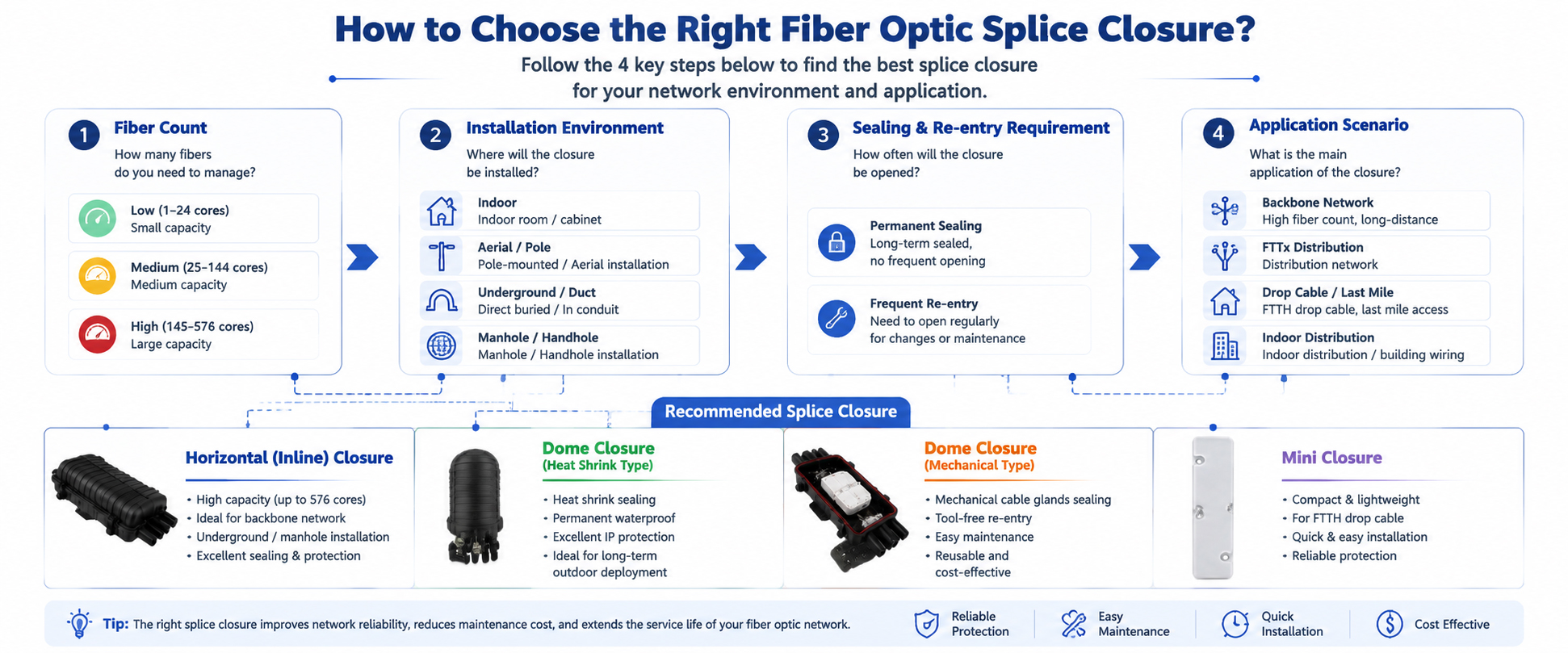
4. Match the Application Scenario
The application determines the most suitable closure design.
|
Application |
Recommended Closure |
|---|---|
|
Backbone Network |
Horizontal Closure |
|
FTTx Distribution Network |
Dome Closure |
|
Pole-mounted Network |
Dome Closure |
|
Underground / Duct Installation |
Horizontal or Dome Closure |
|
FTTH Drop Cable |
Mini Closure |
|
Indoor Distribution |
Mini Closure |
Quick Selection Guide
If you’re unsure which splice closure is best for your project, the following recommendations provide a simple starting point:
- Need maximum fiber capacity? → Choose a Horizontal Closure.
- Need versatile outdoor deployment? → Choose a Dome Closure.
- Need compact protection for FTTH drop cables? → Choose a Mini Closure.
Conclusion
Choosing the right fiber optic splice closure is essential for ensuring long-term network reliability, protecting fiber splice points, and reducing maintenance costs. The best choice depends on your fiber count, installation environment, sealing requirements, and application scenario.
Horizontal closures are ideal for high-capacity backbone networks, dome closures provide versatile protection for outdoor and FTTx deployments, while mini closures offer a compact solution for FTTH drop cable and last-mile installations.
By understanding the strengths of each closure type and matching them to your project requirements, you can build a more reliable, scalable, and cost-effective fiber optic network.
Need Help Choosing the Right Fiber Optic Splice Closure?
FASOCOM offers a complete range of horizontal, dome, and mini fiber optic splice closures for FTTH, FTTx, access, and backbone networks. Our technical team can help you select the most suitable solution based on your installation environment and project requirements.

Single Mode vs. Multimode Fiber: A Practical Guide
Related Article