
Single Mode vs. Multimode Fiber: A Practical Guide
As fiber optic networks continue to expand across data centers, enterprise campuses, and telecommunications infrastructure, selecting the right fiber type is essential for achieving reliable performance and long-term scalability. The two most widely used options are single mode fiber (SMF) and multimode fiber (MMF), each designed for different transmission distances and network requirements.
Single mode fiber is optimized for long-distance communication and high-bandwidth applications, while multimode fiber is commonly used for shorter links within buildings and data centers. Choosing the wrong fiber type can lead to unnecessary costs or limited network performance.
This guide explains the key differences between single mode and multimode fiber, compares their characteristics and applications, and helps you determine which solution best fits your network.
Understanding Single Mode and Multimode Fiber
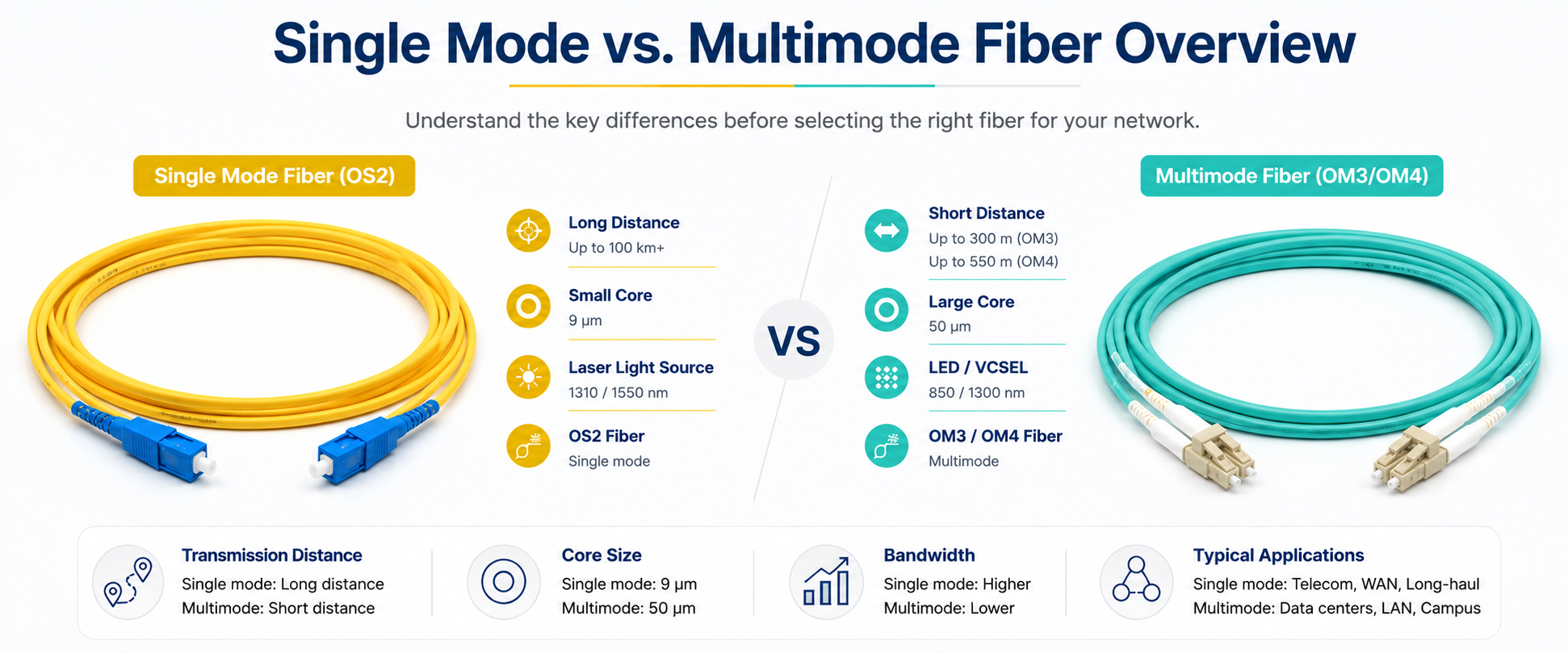
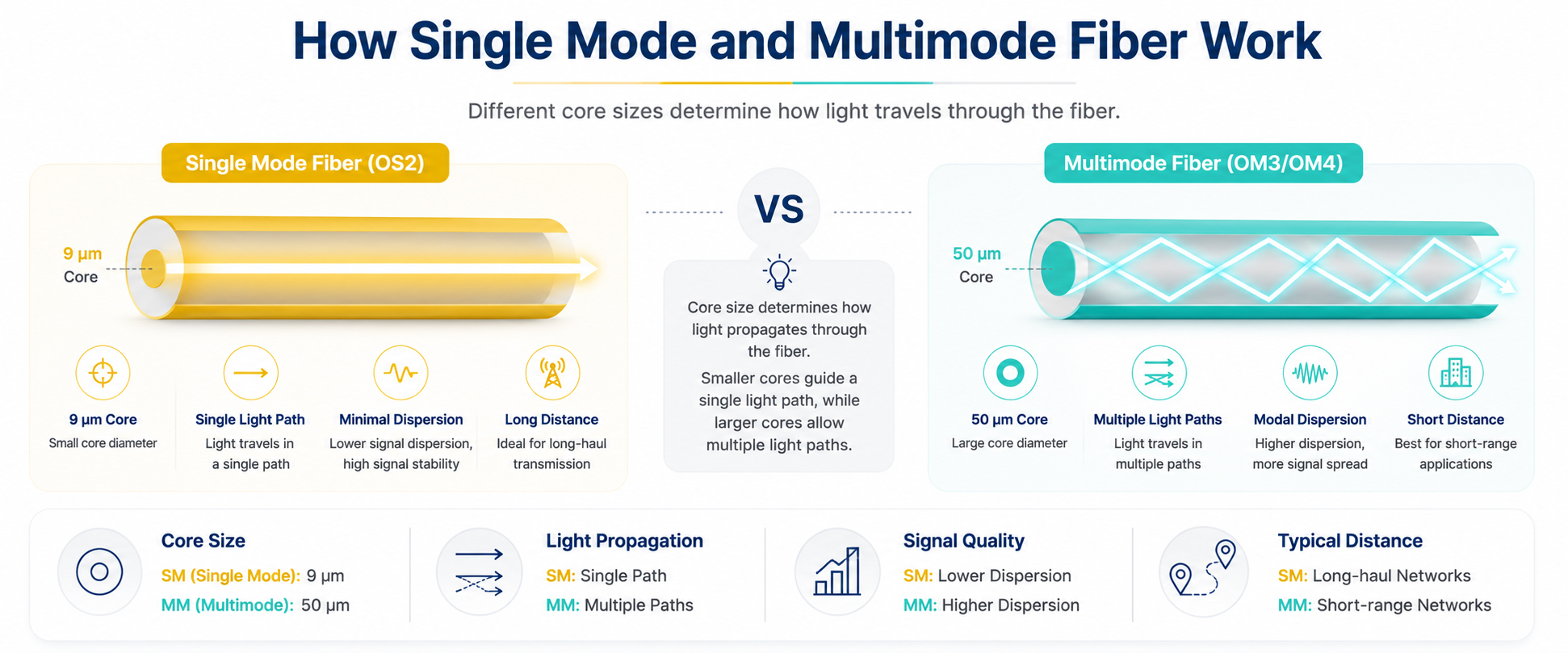
Fiber optic cables transmit data as pulses of light through a glass core, enabling high-speed and low-loss communication. Depending on the core size and transmission method, optical fibers are generally classified into single mode fiber (SMF) and multimode fiber (MMF).
Single mode fiber features a small 9 μm core that allows only one light path to propagate. This design minimizes signal dispersion, making it ideal for long-distance transmission, high-bandwidth applications, metropolitan networks, and telecommunications infrastructure. Single mode fiber is commonly available as OS1 and OS2, with OS2 being the preferred choice for modern outdoor and long-haul deployments.
Multimode fiber has a larger 50 μm or 62.5 μm core, allowing multiple light paths to travel simultaneously. While this limits transmission distance due to modal dispersion, multimode fiber offers a cost-effective solution for short-range communication inside buildings, enterprise campuses, and data centers. The most common types used today are OM3, OM4, and OM5, which support increasingly higher transmission speeds over short distances.
Although both fiber types transmit optical signals, they are designed for different network environments. Understanding their characteristics helps ensure the right balance between performance, scalability, and deployment cost.
Technical Comparison: Single Mode vs. Multimode Fiber
Although both single mode and multimode fibers transmit data using light, they differ significantly in core size, light source, transmission distance, bandwidth characteristics, and deployment cost. Understanding these technical differences helps network designers and IT professionals choose the most suitable fiber solution for their specific applications.
The following comparison summarizes the key characteristics of each fiber type, providing a quick reference for evaluating their performance and typical deployment scenarios.
|
Feature |
Single Mode Fiber (OS1 / OS2) |
Multimode Fiber (OM3 / OM4 / OM5) |
|
|---|---|---|---|
|
Core Diameter |
9 μm |
50 μm (62.5 μm for legacy OM1/OM2) |
|
|
Light Source |
Laser |
VCSEL / LED |
|
|
Operating Wavelength |
1310 / 1550 nm |
850 / 1300 nm |
|
|
Typical Transmission Distance |
Up to tens of kilometers |
Up to 300–550 m at high speeds |
|
|
Bandwidth Performance |
Excellent over long distances |
Excellent over short distances |
|
|
Signal Dispersion |
Very Low |
Higher (Modal Dispersion) |
|
|
Optical Module Cost |
Higher |
Lower |
|
|
Typical Applications |
Telecom, DCI, MAN, WAN, ISP Networks |
Data Centers, Enterprise LAN, SAN, Campus Networks |
When Should You Choose Single Mode Fiber?
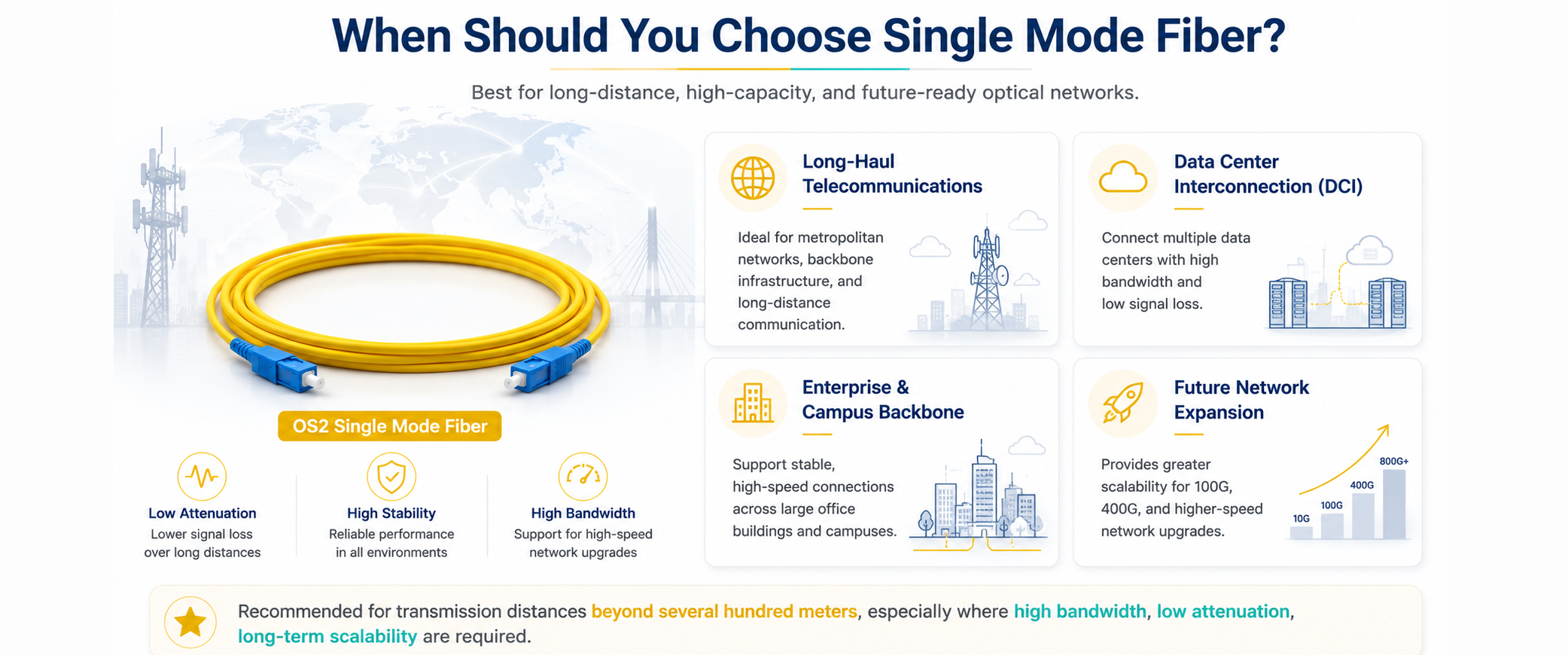
Single mode fiber is the preferred solution for networks that require long transmission distances, high bandwidth, and maximum reliability. Thanks to its small 9 μm core and minimal signal dispersion, it delivers stable optical performance over distances ranging from several kilometers to more than 100 kilometers, depending on the transceiver and network design.
It is widely deployed in telecommunications networks, metropolitan area networks (MAN), wide area networks (WAN), data center interconnection (DCI), and enterprise backbone infrastructure, where maintaining signal integrity over long distances is essential.
Although single mode optics typically involve a higher initial investment than multimode solutions, they provide superior scalability for 100G, 400G, and future high-speed network upgrades. For organizations planning long-term infrastructure expansion, single mode fiber is often the most future-proof choice.
When Should You Choose Multimode Fiber?
Multimode fiber is the preferred choice for short-distance, high-speed networks where cost efficiency and simplified deployment are key considerations. It is widely used in data centers, enterprise LANs, storage area networks (SAN), and campus networks, where transmission distances typically remain within a few hundred meters.
Modern multimode fibers such as OM3, OM4, and OM5 support high-speed Ethernet applications including 10G, 25G, 40G, and 100G over short distances. Combined with cost-effective VCSEL-based optical transceivers, multimode solutions offer excellent performance while reducing overall deployment costs.
If your network is primarily deployed within a single building or campus, requires high-speed connectivity over short distances, and has budget considerations, multimode fiber is often the most practical and economical choice.
Conclusion
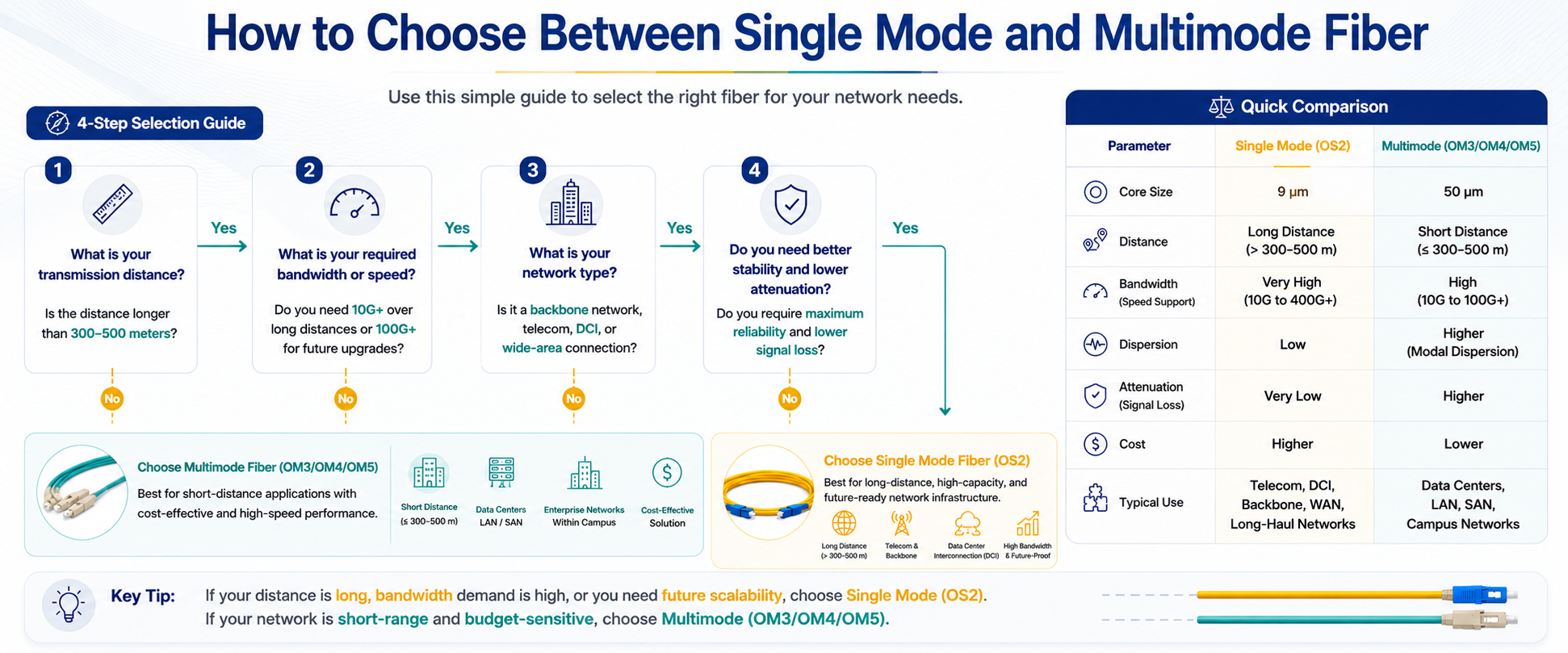
Choosing between single mode and multimode fiber is not about determining which technology is better—it is about selecting the right solution for your specific network requirements.
Single mode fiber excels in long-distance transmission, backbone infrastructure, and future high-speed network expansion, while multimode fiber provides an efficient and cost-effective solution for short-range enterprise and data center applications.
By evaluating factors such as transmission distance, bandwidth requirements, network architecture, scalability, and budget, you can confidently select the fiber type that delivers the best balance of performance, reliability, and long-term value.
Need Help Choosing the Right Fiber for Your Network?
Whether you’re building a new data center, upgrading an enterprise network, or planning a long-distance fiber backbone, FASOCOM offers a complete range of single mode and multimode fiber optic solutions to meet your project requirements.

How to Choose the Right Fiber Optic Splice Closure?
Related Article