Knowledge Sharing | Fiber Optic Cable Knowledge Q&A
2023-08-25
Fiber Optic Cable Knowledge Q&A
1.What are the advantages of using optical fibers?
Optical fibers have a wide bandwidth, theoretically up to 30T.
The distance without repeaters can reach tens to hundreds of kilometers, while copper wires are limited to hundreds of meters.
Immune to electromagnetic fields and radiation.
Lightweight and compact.
Optical fiber communication is non-electric, making it safe for use in flammable and explosive environments.
Wide operating temperature range.
Long lifespan.
The distance without repeaters can reach tens to hundreds of kilometers, while copper wires are limited to hundreds of meters.
Immune to electromagnetic fields and radiation.
Lightweight and compact.
Optical fiber communication is non-electric, making it safe for use in flammable and explosive environments.
Wide operating temperature range.
Long lifespan.
2.How to choose fiber optic cables?
The selection of fiber optic cables involves considering not only the fiber core count and type but also the cable's environmental usage, structure, and outer sheath.
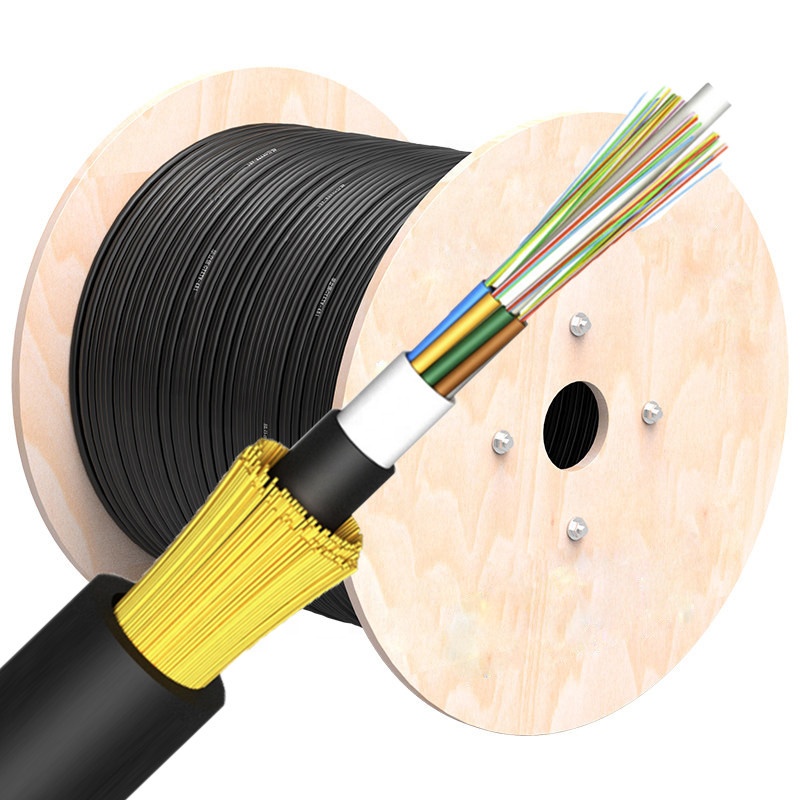
For outdoor buried applications, armored loose-tube cables are suitable. For aerial installation, loose-tube cables with black PE outer sheaths and multiple strengthening members are appropriate.
Indoor cables should be chosen based on tight-buffering and properties such as flame resistance, toxicity, and smoke generation. Options include flame-retardant with smoke (Plenum) or non-toxic and non-combustible (LSZH) cables.
Vertical or horizontal cabling within buildings can use tight-buffer, distribution, or branch cables.
Choose between single-mode and multi-mode fiber cables based on network and cable application parameters. Multi-mode cables are suitable for short-distance indoor applications, while single-mode cables are preferred for outdoor and long-distance scenarios.
3.In fiber optic connections, what are the different applications for fixed and active connections?
Active connections in fiber optics are achieved through connectors. An active connection point in an optical link serves as a distinct separation interface. When choosing between active and fixed connections, fixed connections have advantages of lower cost and lower optical loss, but they lack flexibility. Active connections offer the opposite benefits. In network design, a flexible combination of active and fixed connections should be chosen to ensure stability and flexibility, enhancing both connection types' advantages. Active connections also serve as important points for testing, maintenance, and changes, aiding fault detection and device replacement, thereby improving system maintenance and reducing costs.
4.As fiber optics get closer to end-users, what is the significance of "fiber to the desktop," and what factors need attention in system design?
"Fiber to the desktop" is crucial in horizontal subsystem applications, complementing copper cables. Fiber optics offer unique advantages such as long-distance transmission, stability, immunity to electromagnetic interference, high bandwidth support, and no electromagnetic leakage. Fiber optics are indispensable in specific environments:
A.For distances exceeding 100m, using copper cables would require costly repeaters or additional network equipment. Fiber optics easily resolve this issue.
B.In environments with significant electromagnetic interference, such as factories or power rooms, fiber optics operate stably due to their immunity.
C.Fiber optics do not leak electromagnetic signals, making them suitable for high-security areas like military, research, and government sectors.
D.High-bandwidth needs of over 1G are well-served by fiber optics.
As fiber optics extend to desktops and residences, users unfamiliar with fiber characteristics are introduced to fiber systems. Designing fiber link systems and selecting products should consider current and future application requirements, compatibility, ease of maintenance and management, and adaptability to varying on-site conditions and user installation needs.
5.Can fiber optic connectors be directly terminated on 250 µm fibers?
No, it's not possible. Loose-tube cables include bare fibers with an outer diameter of 250 µm. These fibers are extremely small and fragile, incapable of supporting the weight of connectors. Terminating connectors directly onto cables requires a 900 µm tight buffer layer around the 250 µm fiber to provide protection and support for the connector.
6.Can FC connectors be directly connected to SC connectors?
Yes, this is achievable by using hybrid adapter connectors such as FC/SC adapters, connecting FC and SC connectors on both ends. It's important to ensure that the connectors are flat-polished. If an angled (APC) connector needs to be connected, a different approach is necessary.
7.Fiber optic fixed connections involve mechanical splicing and fusion splicing. What are the selection principles for these two methods?
Mechanical splicing, often called cold splicing, is a method of permanently connecting single-core or multi-core fibers using mechanical connection techniques without fusion splicing equipment. Mechanical splicing is preferred over fusion splicing for splicing small-core fibers that are dispersed across multiple locations due to its simplicity and cost-effectiveness.
Mechanical splicing was initially used for quick repairs and special occasions. With the widespread deployment of fiber to the desktop and fiber to the home (FTTH), mechanical splicing has gained importance as a fiber splicing method.
In FTTH applications, when the user scale becomes substantial and fusion splicing tools cannot meet the demand for quick service provisioning, mechanical splicing becomes more suitable due to its simplicity, shorter training time, lower equipment costs, and practicality in challenging installation scenarios.
8.What are the differences between the requirements for fiber optic splice closures in fiber-to-the-home systems and those used in outdoor lines by telecommunications operators?
In fiber-to-the-home systems, splice closures must accommodate splitters, jumper cables, and allow for easy installation and protection of splitters at various locations, as splitters may be located in splice closures, fiber distribution cabinets, distribution frames, and other facilities.
Additionally, for residential areas, splice closures are often installed underground, so they require better burial performance.
Moreover, fiber-to-the-home projects often involve numerous small-core fiber cables entering and exiting splice closures.
About Faso
Founded in 2007, Faso Photonics Technology Limited Company is a professional company engaged in the development, manufacturing and distribution of optical fiber network and telecommunications products, such as optical cables, optical fiber jumpers, optical fiber tails, PLC splitters, distribution frames, connector boxes and other FTTX products. Professional products and first-class services have established a good business network for us, and we look forward to establishing long-term cooperative relations with you.
Welcome to exchange more knowledge about optical fiber and cable.
Fiber Optic Terminal Boxes: Ensuring Network Stability
Fiber Optic Cables: Transmission Medium for Communication
Related Article


1、Core Definition and Working Principle
2、 Key Characteristics
3、 Main Classifications
4、Core Differences from Multimode Fiber
5、Typical Application Scenarios
2、 Key Characteristics
3、 Main Classifications
4、Core Differences from Multimode Fiber
5、Typical Application Scenarios
What is single-mode fiber optic?